The witch’s look · from Circe to now

Her hat, her broom, her cat. Every piece has a date.

Witch

Her hat, her broom, her cat. Each piece of the witch arrived in a different century, from a different story. Here is where each piece came from, in the old pictures themselves, and the beer story you may have heard. At the end: which witch are you?

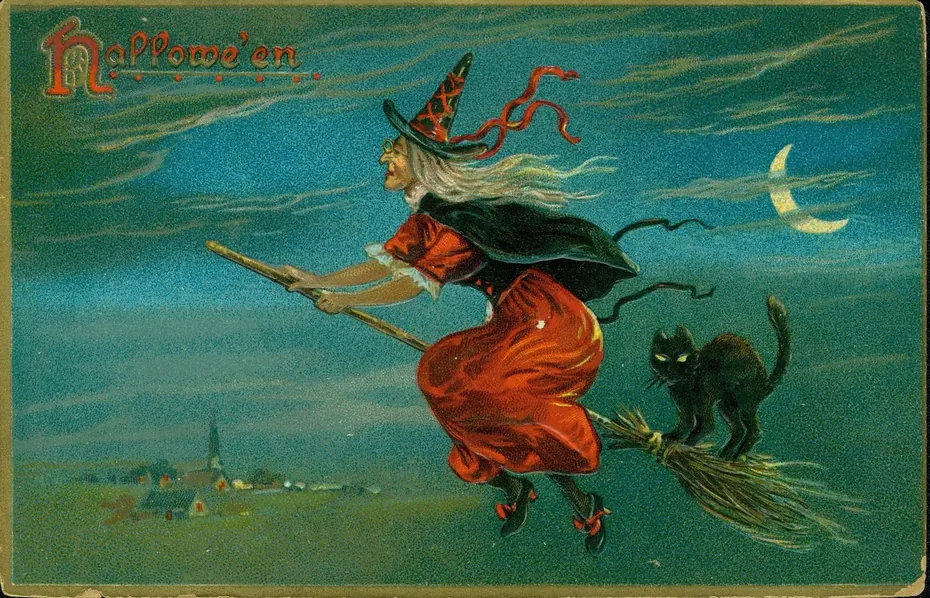
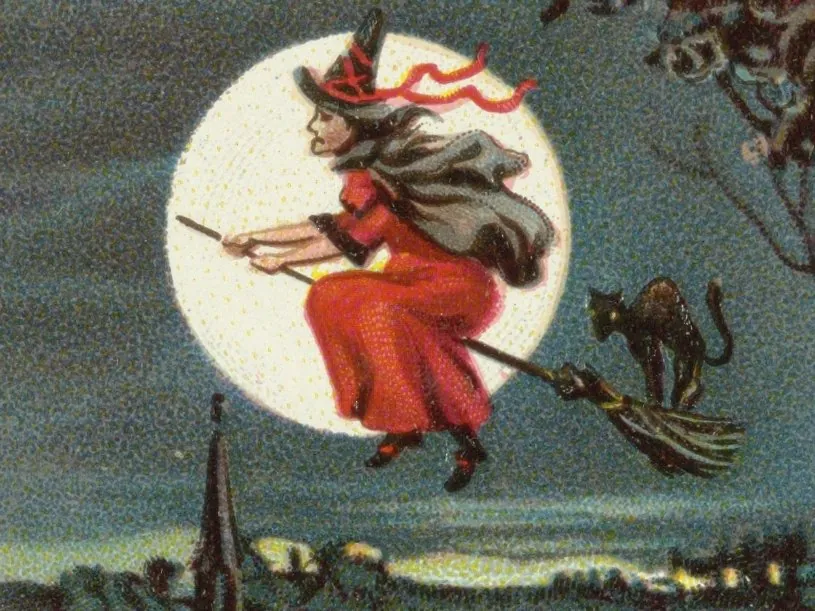
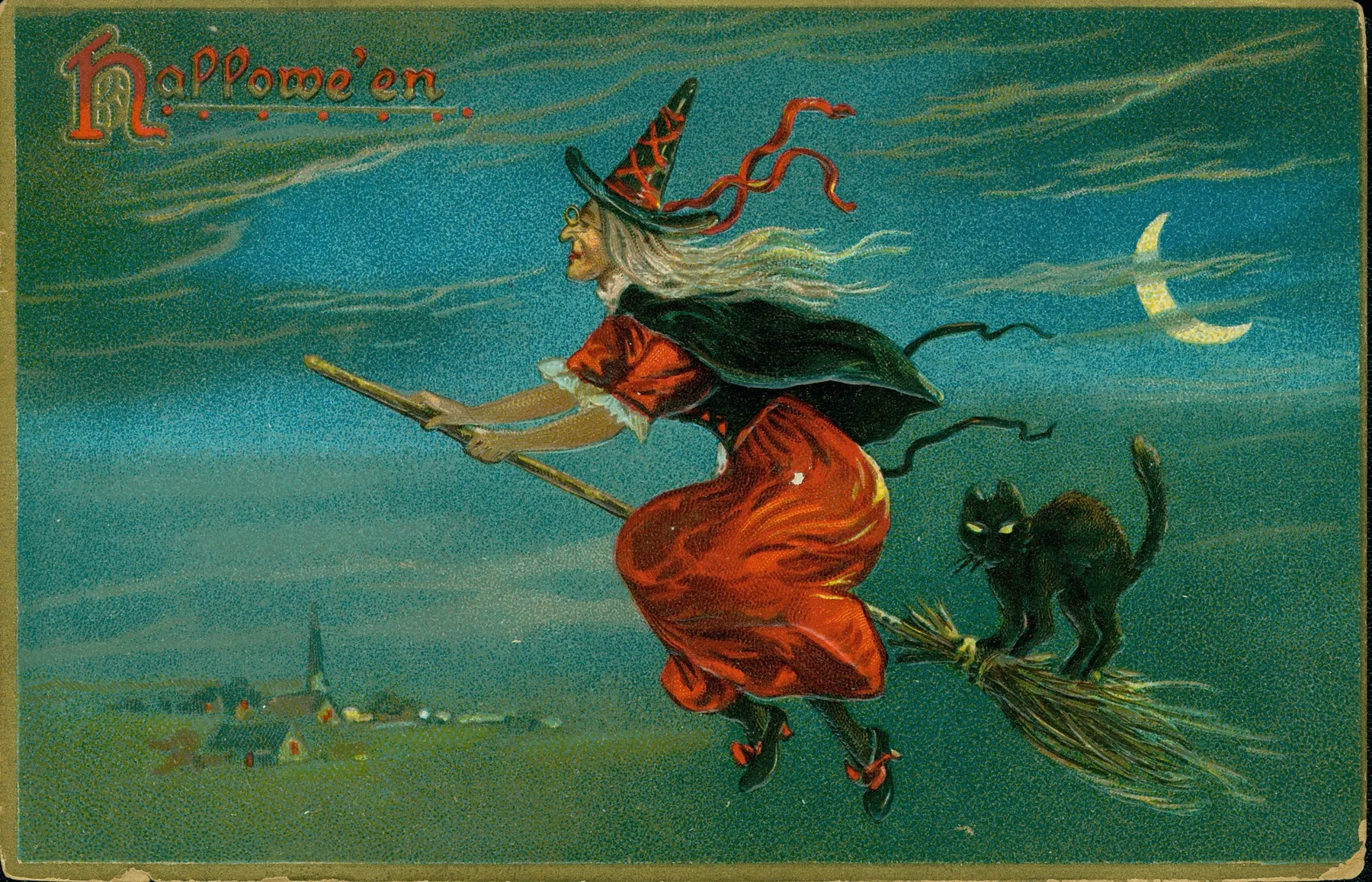
A witch on a broomstick, seen close: her pointed black hat, laced and tied with red ribbons.
“Hallowe’en” · postcard, Raphael Tuck & Sons, about 1908
The hatFirst seen1600severyday wear in England

The pointed hat

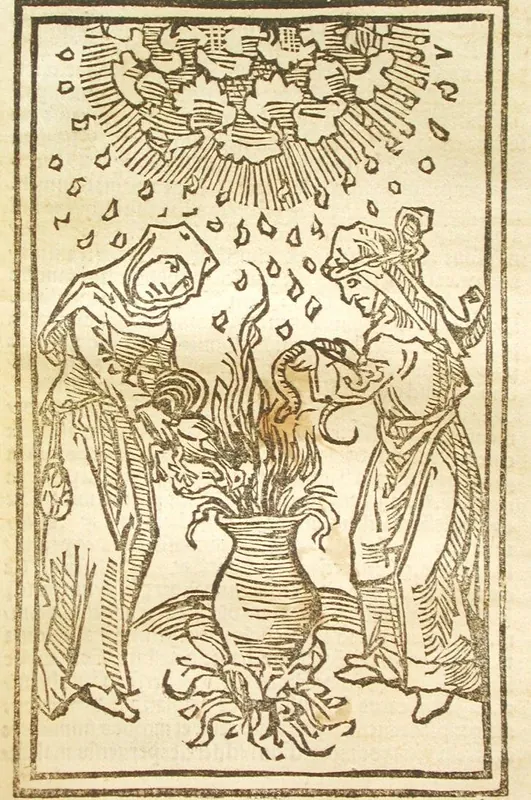
In the oldest pictures of witches, nobody wears a pointed hat. The first printed book about witches with pictures, Ulrich Molitor’s, around 1489, shows them in headscarves and everyday dresses, like any woman in town.

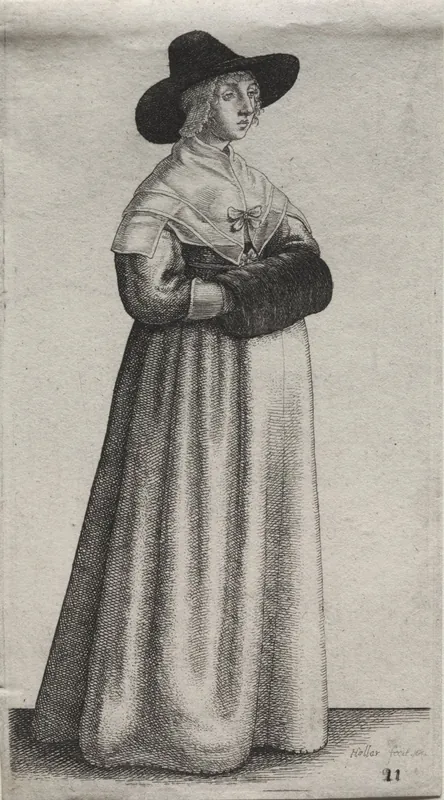
Then, in the 1600s, a tall hat was simply the fashion in England. Women wore it to market and to church. One idea from dress historians: the fashion moved on, and the hat stayed on the old country woman in pictures, until it became the look of someone old, rural and a little out of time.

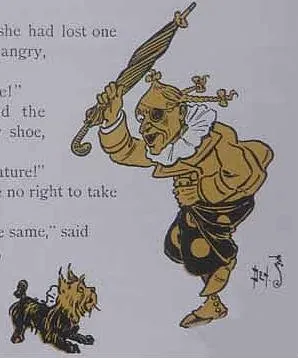
By 1720, cheap English books about witches give them tall pointed hats. By the Halloween postcards of the 1900s, the point is sharp and the brim is wide. And in The Wonderful Wizard of Oz, in 1900, the pointed hat is worn by the good witch. The wicked one has one eye, pigtails and an umbrella.
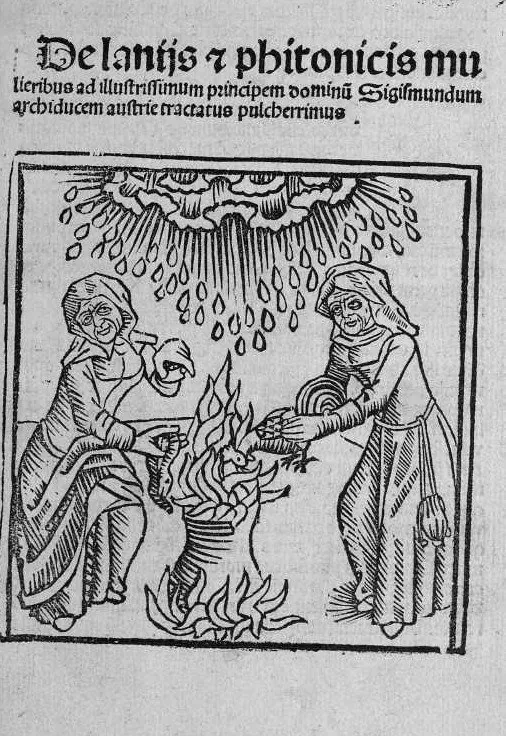
Woodcut under a Latin book title: two women in headscarves pour things into a burning cauldron while hail falls from above.
1489Witches in headscarves. No hats.Ulrich Molitor’s book on witches · Universitätsbibliothek, via Commons
Etching of a woman standing in a long dark dress, white collar and tall black hat, her hands in a muff.
1640An English woman in the tall hat everyone woreWenceslaus Hollar · Cleveland Museum of Art 1939.609
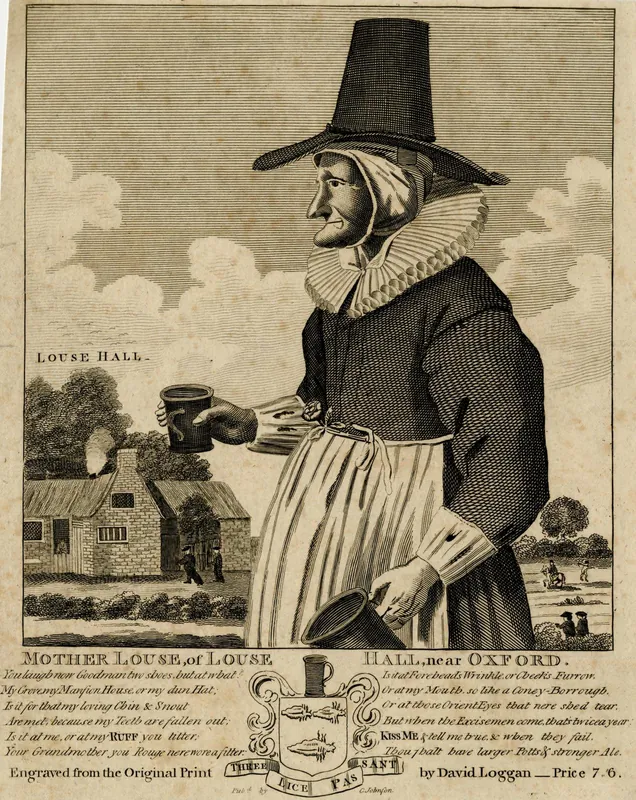
Engraving of an old woman in profile in a tall black hat, ruff and apron, holding out a mug, a thatched inn behind her.
1670sMother Louse, who kept an alehouse near Oxfordafter David Loggan · British Museum Ee,6.130
Oz’s wicked witch: an umbrella, no pointed hat
1900Oz’s wicked witch: an umbrella, no pointed hatW. W. Denslow · first edition, via Commons
Postcard: a witch in a pointed hat, black cape and red dress rides a broom across a blue night sky, a black cat behind her.
1908The whole look, at lastRaphael Tuck & Sons · Missouri History Museum, via Commons

The alewife story

You may have heard this one.

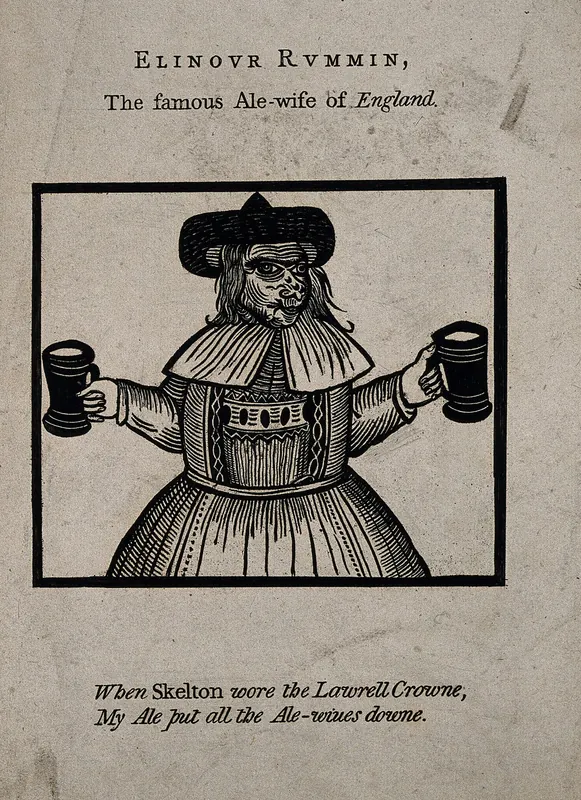
Woodcut of a heavy old woman in a wide dark hat and ruff, a mug raised in each hand.
1624Elinour Rummin, “the famous ale-wife of England”after the 1624 woodcut · Wellcome Collection, CC BY 4.0
Engraving of an old woman in profile in a tall black hat, ruff and apron, holding out a mug, a thatched inn behind her.
1670sMother Louse of Louse Hall, near Oxfordafter David Loggan · British Museum

In the Middle Ages, women brewed the ale. Many were widows who needed a living. To be seen at a crowded market they wore tall pointed hats. They brewed in big cauldrons, hung a broom outside to say the ale was ready, and kept cats to guard the grain from mice. Then the men took the trade, and the women who still brewed were called witches.

It’s a lovely story, and a lot of it is true:

What nobody has found is the thread that ties them together. No old source says the sign was a broom, or that brewers’ cats became witches’ cats. Christina Wade read the English, Scottish and Welsh witch trials and found no woman accused because she brewed. And the cauldron is far older than any brewster: it was already Medea’s.

A witch on a broomstick, seen close: the broom under her, a black cat on its bristles.
“Hallowe’en” · postcard, Raphael Tuck & Sons, about 1908
The broomFirst seen1451a French poem

The broom

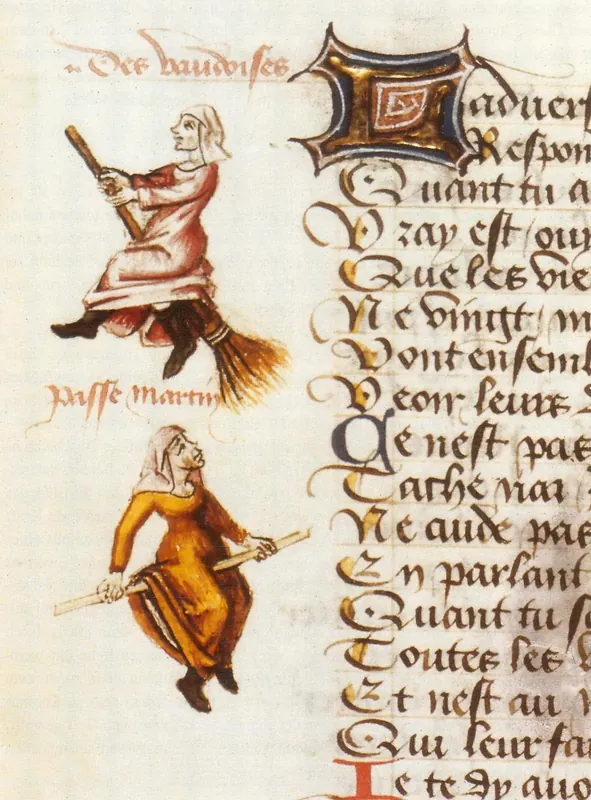
The broom first appears in writing in the 1430s, in a list of accusations from the Alps: people “who ride a broom or a stick”. In 1451, a scribe copying Martin Le Franc’s long poem in defence of women drew two women flying in the margin, one on a broom and one on a stick. It’s the oldest picture of witches on brooms anyone has found, and the poem’s champion says they can’t fly at all.

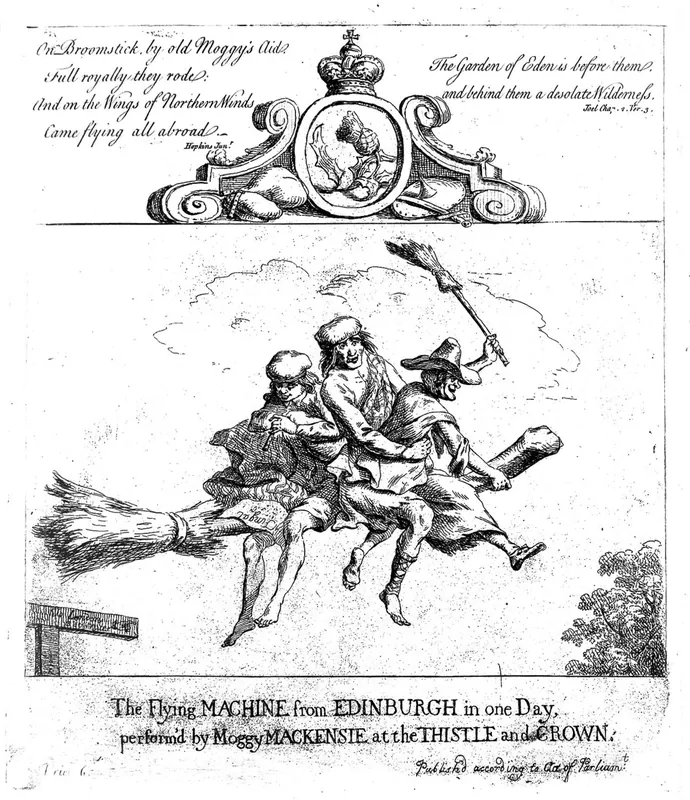
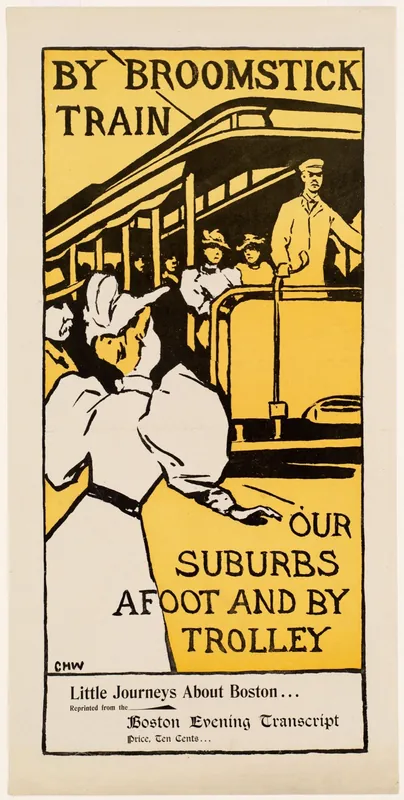
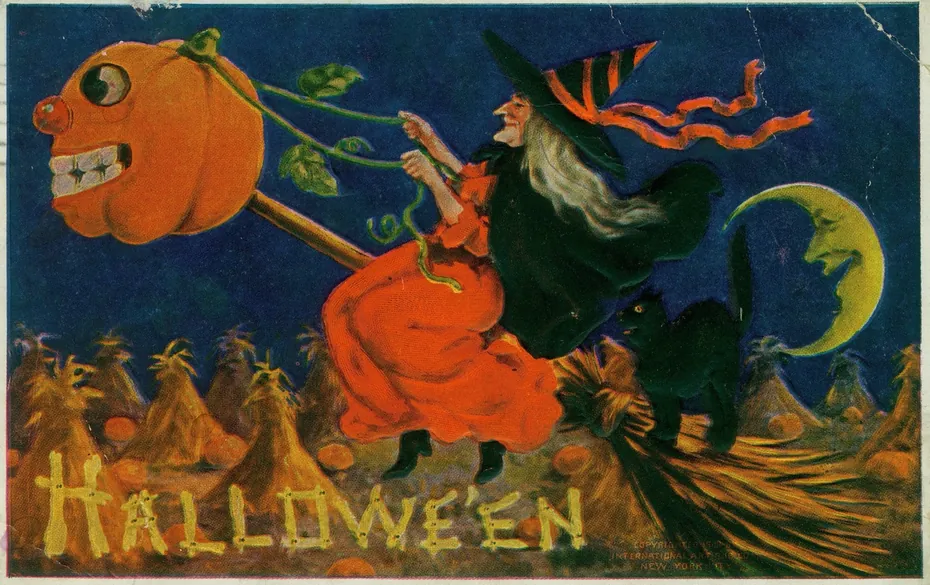
Why a broom? The simplest answer historians give: it was the thing almost every woman held every day. By 1762 it was a London joke, with Scotsmen flying in on a witch’s broomstick. In 1895 Boston sold its new electric trams as the “broomstick train”. By 1910, she’s on her broom on every Halloween postcard.

Margin of a manuscript page: two women in headscarves ride through the air, one on a broom, one on a stick.
1451Two women flying, one on a broomLe Champion des Dames · Bibliothèque nationale de France
Etching: three people in hats ride one long broom through the air, the one in front waving a small broom.
1762“The Flying Machine from Edinburgh”, a London jokesatirical print · Wellcome Collection
Yellow and black poster: a woman in big sleeves in front of a Boston trolley car, with the words By broomstick train.
1895Boston’s “broomstick train”Charles Herbert Woodbury · Digital Commonwealth, via Commons
Postcard: a flying jack-o’-lantern pulls a witch on her broom past a crescent moon, above a field of corn stooks.
1910A jack-o’-lantern pulls her broomHalloween postcard · Missouri History Museum, via Commons
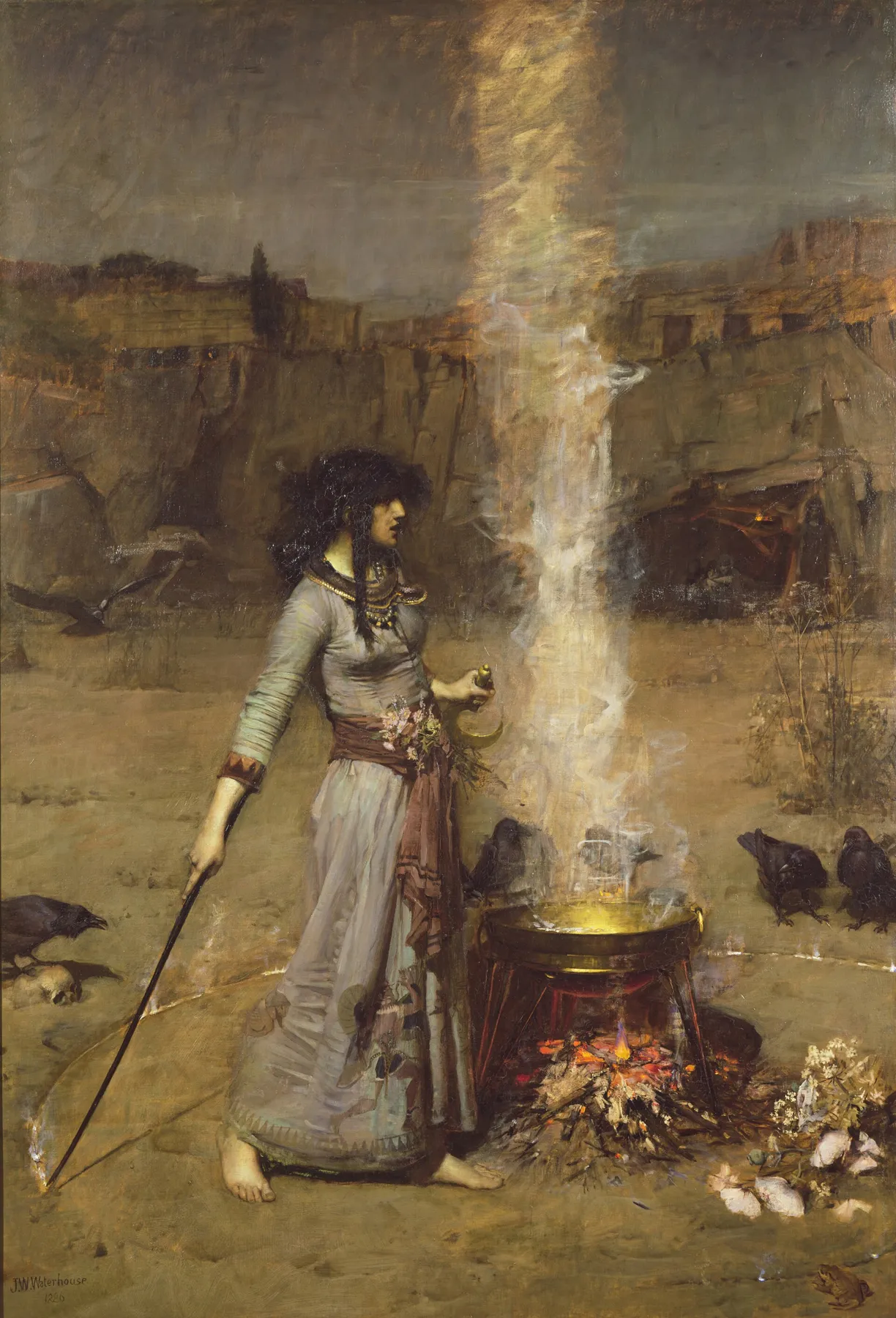
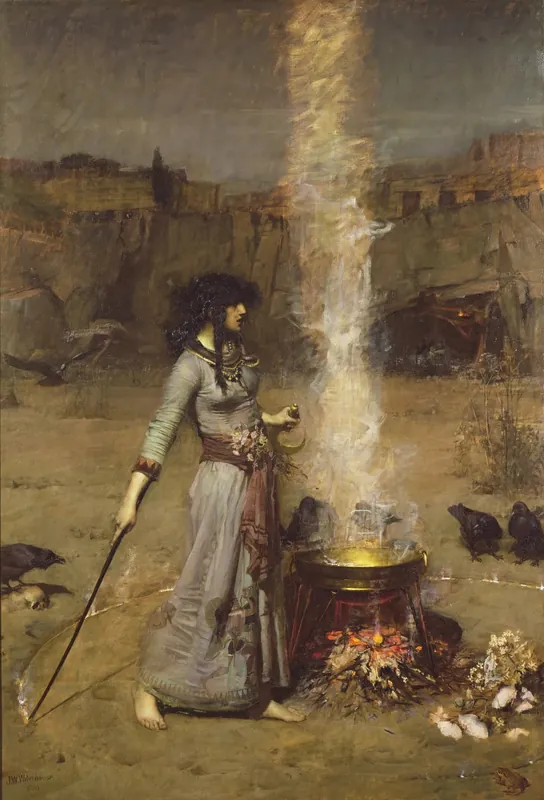
Painting: a woman in a long robe stands over a smoking cauldron on a fire, crows around her.
The Magic Circle · John William Waterhouse, 1886
The cauldronFirst seen8 CEOvid, the Metamorphoses

The cauldron

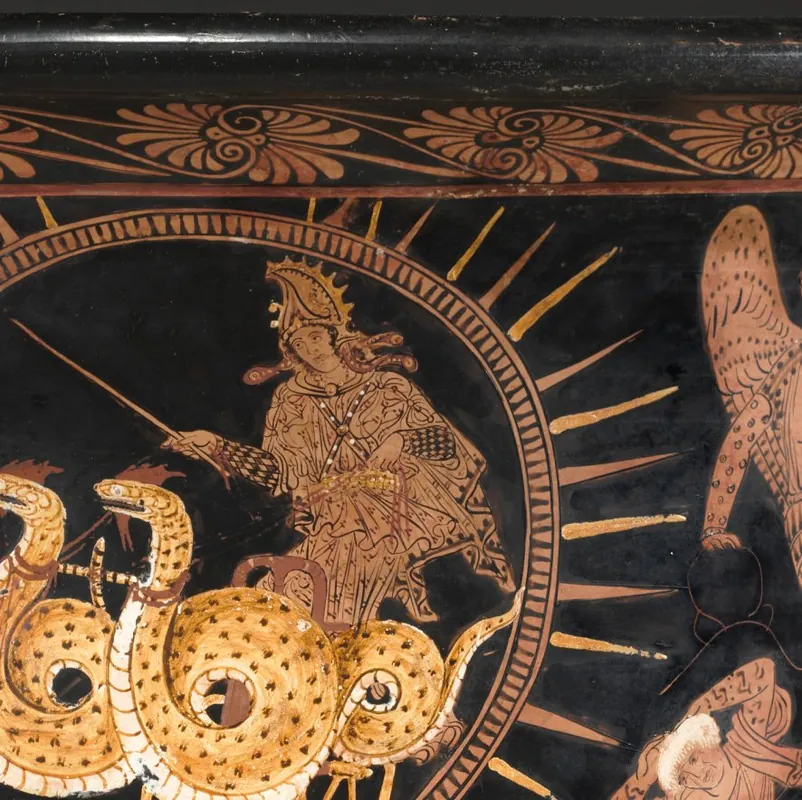
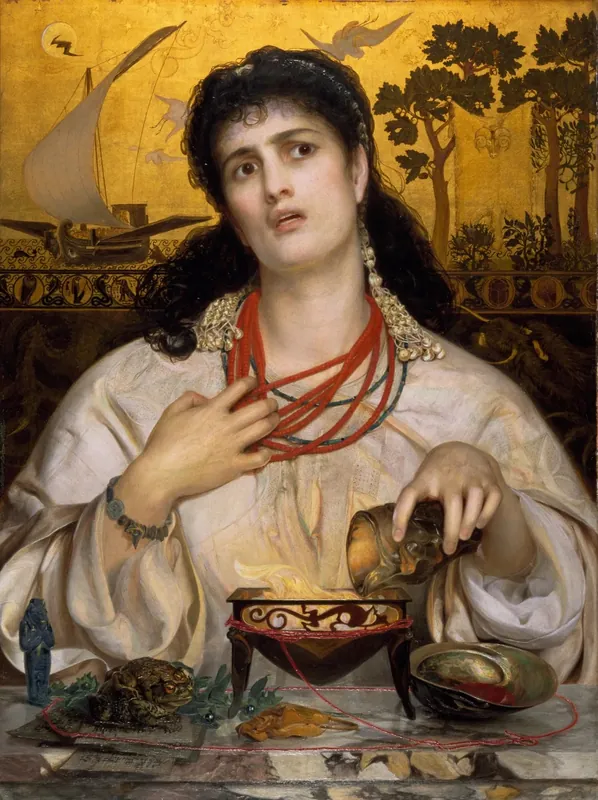
The witch’s pot is the oldest piece of kitchen in the story. In Ovid, written by 8 CE, Medea boils her herbs in a bronze cauldron and stirs it with a dry old olive branch. The branch turns green, and grows olives. Greek vase painters loved her: around 400 BCE one painted her flying off in the Sun’s chariot, pulled by snakes.

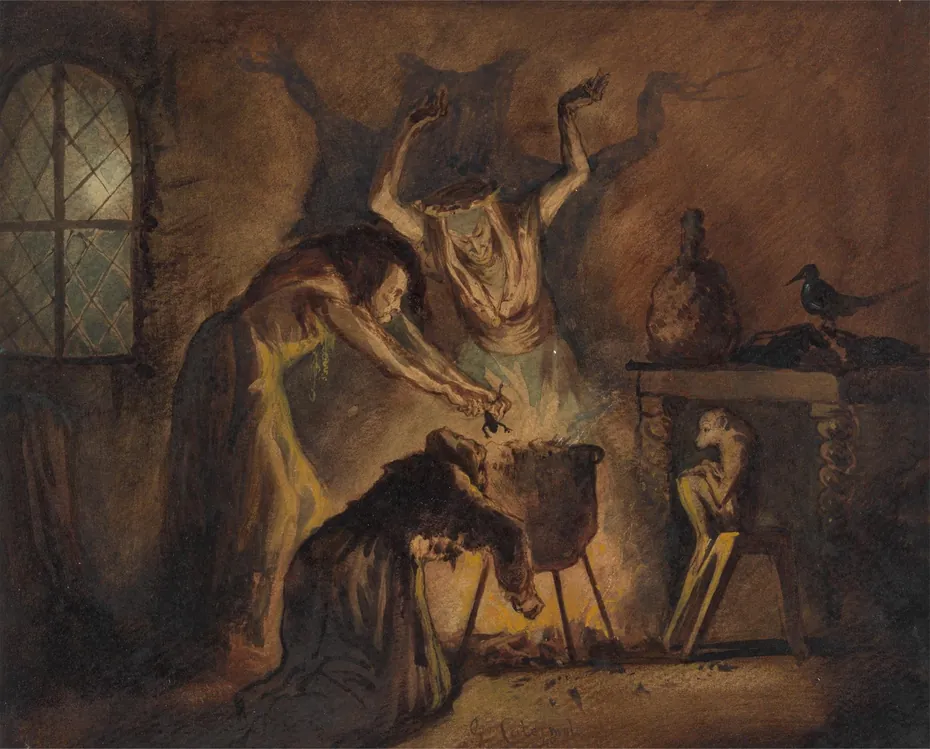
In 1489, Molitor shows two women putting things into a pot to brew a hailstorm. Around 1606 Shakespeare gives the cauldron its song, “Double, double toil and trouble; fire burn and cauldron bubble”, and every Victorian Macbeth after that put three women round it.

Painted Greek vase: a figure in a patterned robe stands in a chariot drawn by two snakes, inside a ring of sun rays.
400 BCEMedea in the Sun’s chariotPolicoro Painter · Cleveland Museum of Art 1991.1
Medea boils her herbs in a bronze pot and stirs it with a dry olive branch. The branch turns green, and grows olives.
8 CEOvid, Metamorphoses 7.275–284
Woodcut: two women stand over a burning cauldron and hail falls from the sky above them.
1489Two women brewing a hailstormUlrich Molitor · via Commons
Dark painting: hooded figures bend over a smoking cauldron in a room with an arched window, a horned shape rising in the smoke.
1840Macbeth’s three witchesGeorge Cattermole · Yale Center for British Art
Painting: a dark-haired woman in a coral necklace pours from a small jug into a bowl and looks up, a gold sky behind her.
1868Medea and her potionFrederick Sandys · Birmingham Museums
A black cat with its back arched, standing on the bristles of a flying broom.
“Hallowe’en” · postcard, Raphael Tuck & Sons, about 1908
The catFirst seenabout 200 CEa Greek myth

The black cat

The witch’s cat is older than the witch. In a Greek myth, when the monster Typhon came, the gods hid as animals: Apollo as a hawk, Hermes as an ibis, Dionysos as a goat, and Artemis as a cat.

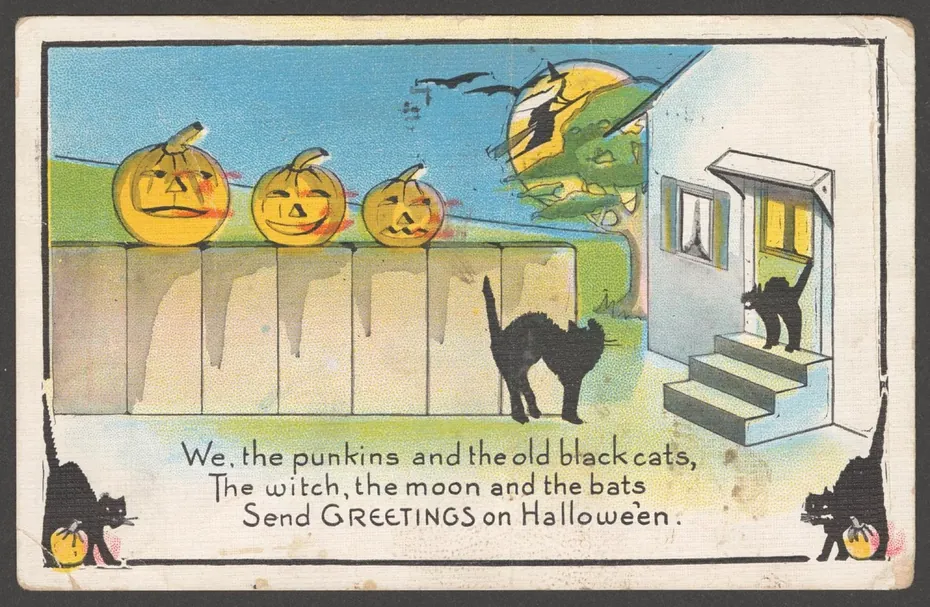
Cats were half at home and half wild, so they belonged to both worlds. By the late 1800s greeting cards put the witch and her black cat together on the broom, and by the 1920s the black cats have taken over the postcards: on her shoulder, on the fence, beside the pumpkins.

When the monster Typhon came, the gods hid as animals. Artemis was a cat.
about 200 CEAntoninus Liberalis, Metamorphoses 28
Greeting card: a witch in red rides a broom across a huge full moon, a black cat on the bristles behind her.
1880sThe cat rides on the bristlesgreeting card · Cooper Hewitt, via Commons
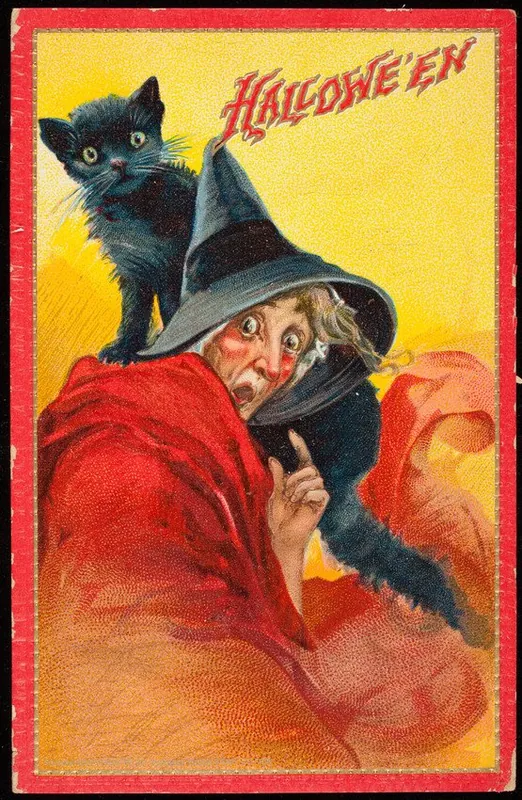
Postcard: a witch in a pointed hat and red cloak looks back at a black cat sitting on her shoulder.
1919A cat on her shoulderRaphael Tuck & Sons · Historic New England, via Commons
Postcard: three jack-o’-lanterns on a garden wall and black cats with arched backs by a doorstep, a witch flying past the moon.
1926“The punkins and the old black cats”Halloween postcard · via Commons
A witch on a broomstick, seen close: her red dress and black cape blowing behind her.
“Hallowe’en” · postcard, Raphael Tuck & Sons, about 1908
The black cloakFirst seen35 BCEHorace, the Satires

The black cloak

The black cloak is in Roman poetry. Around 35 BCE, Horace has a garden statue tell what it saw one moonlit night: “I saw Canidia walking, her black cloak tucked up, barefoot, her hair let down.” That’s nearly the whole Halloween silhouette, two thousand years early.

For centuries after, pictures showed witches in ordinary clothes, because the point was that a witch looked like your neighbour. The dark dress came back with the sober 1600s outfits of country women, and then as a black cape over a red dress on the Halloween postcards.

I saw Canidia walking, her black cloak tucked up, barefoot, her hair let down.
35 BCEHorace, Satires 1.8.23–24
Etching of a woman standing in a long dark dress, white collar and tall black hat, her hands in a muff.
1640A dark dress, a white collar, the hatWenceslaus Hollar · Cleveland Museum of Art
Painting: a barefoot woman with loose dark hair, in a long grey robe, stands by a cauldron with crows around her.
1886Barefoot, hair loose, as Horace wroteJohn William Waterhouse · Tate
Postcard: a witch in a pointed hat, black cape and red dress rides a broom across a blue night sky, a black cat behind her.
1908The black capeRaphael Tuck & Sons · via Commons
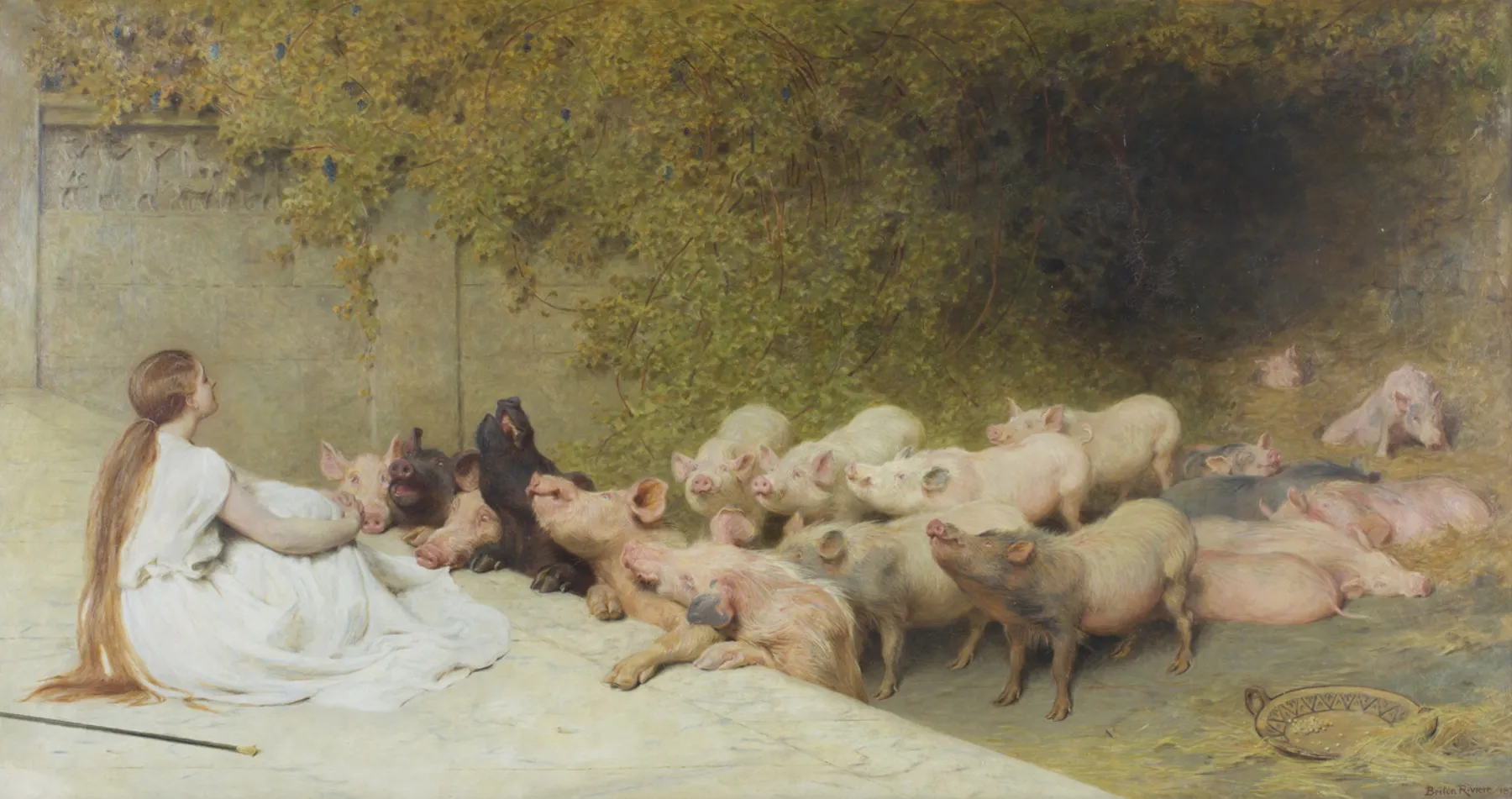
Painting: a woman in white sits among her pigs, a long wand on the ground beside her.
Circe and her Swine · Briton Rivière, 1896
The wandFirst seenabout 700 BCEHomer, the Odyssey

The wand

The wand is the oldest thing she owns. In the Odyssey, around 700 BCE, Circe gives Odysseus’ men a drink, touches them with her wand, and they are pigs. Their minds stay as they were.

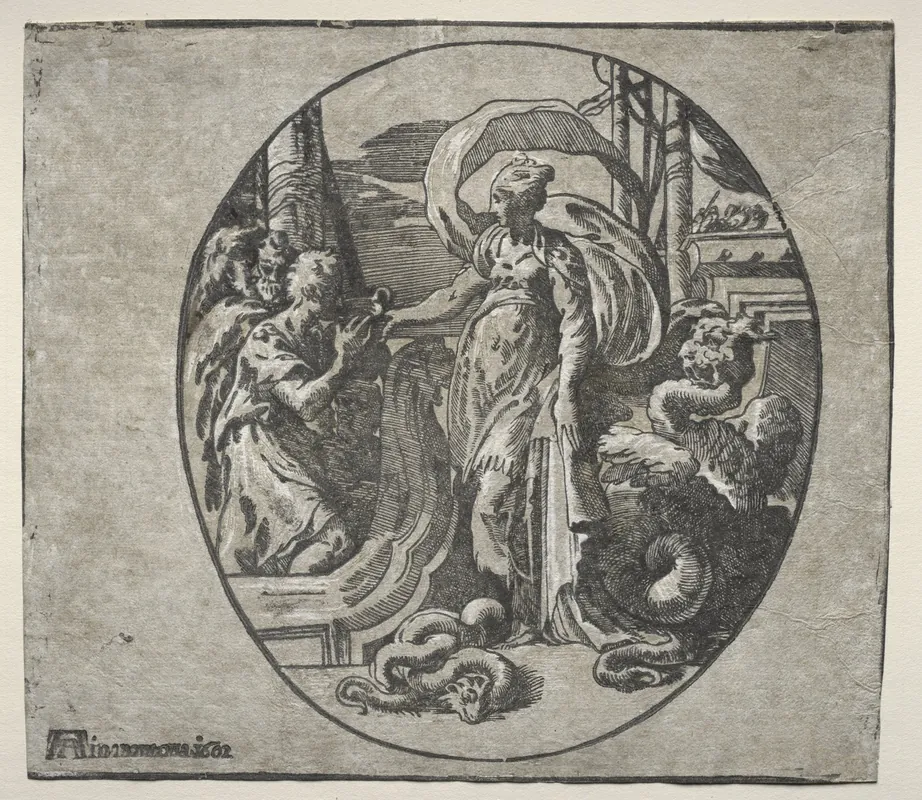
Painters never stopped coming back to her: in the 1540s handing out the cup while the men change, in 1886 a sorceress drawing a circle with hers, in 1896 Circe sitting among her pigs.

She touched them with her wand, and they had the heads and bristles of pigs, but their minds were as before.
about 700 BCEHomer, Odyssey 10.233–240
Round print: a tall woman in flowing robes holds out a cup to a kneeling man, a snake and a beast at her feet.
1540sCirce gives the men her drinkAntonio da Trento · Cleveland Museum of Art 1925.1220
Painting: a barefoot woman with loose dark hair draws a circle on the ground with a long wand, around a smoking cauldron.
1886A wand drawing a circleJohn William Waterhouse · Tate
Painting: a woman in white with very long fair hair sits on the ground in a crowd of pigs, a wand beside her.
1896Circe among her pigsBriton Rivière · via Commons

Which witch are you?

Keep one piece. The one you’d never go out without.

On the 31st

Samhain is the night the dark half of the year begins. Wear what you like. Bring your own light.

Sources

  1. The hat: Ulrich Molitor, De laniis et phitonicis mulieribus, about 1489; felt hat, England 1590–1670, Victoria and Albert Museum T.22-1938; Wenceslaus Hollar, The Several Habits of English Women, 1640; L. Frank Baum, The Wonderful Wizard of Oz, 1900, chapters 2 and 12.
  2. The alewives: John Skelton, The Tunnyng of Elynour Rummyng, about 1517; Geoffrey Chaucer, The Canterbury Tales (the ale-stake); Judith Bennett, Ale, Beer and Brewsters in England, 1996; Christina Wade, The Devil’s in the Draught Lines, and “The Alewife-as-Witch Myth Revisited”.
  3. The broom: Errores Gazariorum, 1430s (in Joseph Hansen, 1901); Martin Le Franc, Le Champion des Dames, 1451, Bibliothèque nationale de France, Français 12476.
  4. The cauldron: Ovid, Metamorphoses 7.275–284; Shakespeare, Macbeth 4.1.
  5. The cat: Antoninus Liberalis, Metamorphoses 28 (Celoria, 1992).
  6. The black cloak: Horace, Satires 1.8.23–24.
  7. The wand: Homer, Odyssey 10.233–240 (Murray, 1919), in our own words.

The pictures

Every picture on this page is public domain or openly licensed. Where each one lives is written under it. The large scenes: “Hallowe’en”, postcard, Raphael Tuck & Sons, about 1908; John William Waterhouse, The Magic Circle, 1886, Tate; Briton Rivière, Circe and her Swine, 1896; Frederick Sandys, Medea, 1866–68, Birmingham Museums; Gerard Dou, Girl with an Oil Lamp at a Window, about 1660, Rijksmuseum SK-A-89; Le Champion des Dames, 1451. Elinour Rummin, Wellcome Collection, CC BY 4.0.

Read on